

Est. 2026 By Pala Labs
Polkadot Daily Digest
Ecosystem intelligence, curated daily
Polkadot Ecosystem Briefing
An authoritative overview of governance, development, and community activity across the Polkadot network. Curated and synthesised daily.
Cumulative Data Points
Recent Editions

All Editions

Polkadot Daily Digest

Editorial Methodology
How the Digest Is Made
A look at the sources, pipeline, and editorial standards behind every edition of the Polkadot Daily Digest.
The Workflow

From signal to story, in five stages.

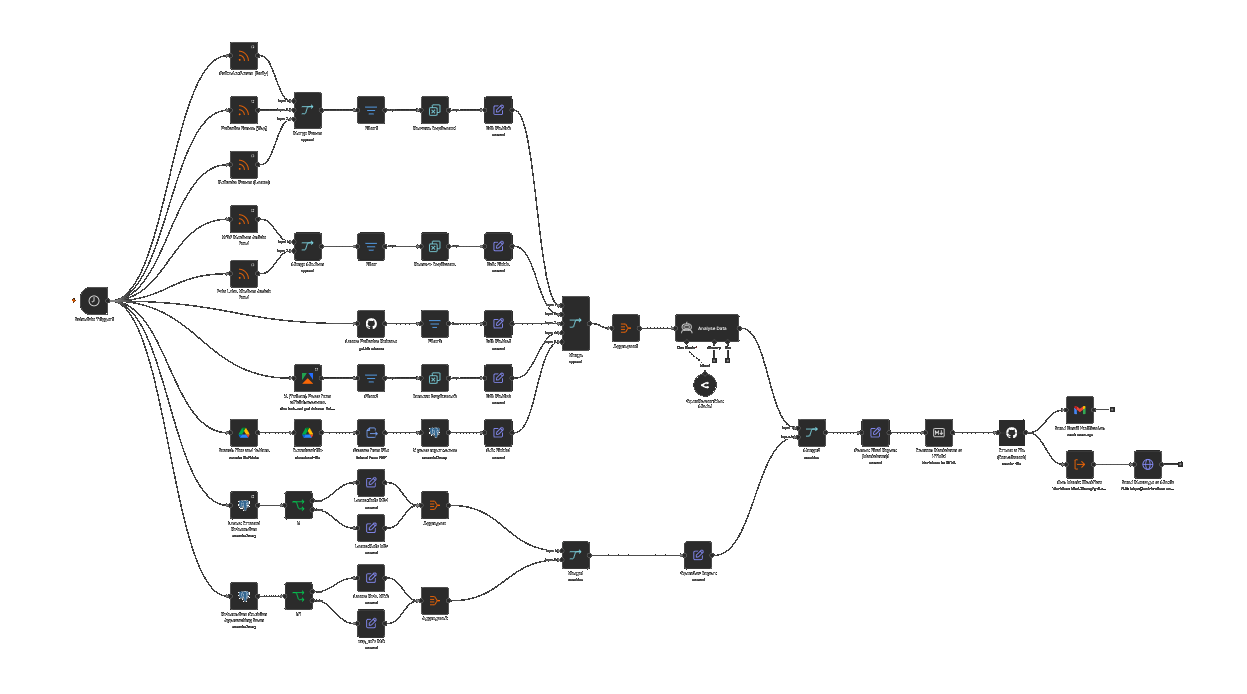
Every morning the same workflow runs end-to-end — gathering material from across the Polkadot ecosystem, filtering noise, and shaping the result into a single, readable briefing. The diagram below is the production pipeline itself, reproduced unaltered.

Polkadot Daily Digest workflow architecture
Plate I.  Production pipeline · Click to view full size
Sources

Where the signal comes from.

Five primary streams feed the digest. Together they cover the venues where Polkadot’s technical and governance conversations actually happen.

Community
Polkadot Forum
Threads and replies from the official forum — Daily, Top, and Latest feeds — the primary venue for technical discussion and governance debate.
Long-form
Medium Articles
Editorial posts from the Web3 Foundation and Pala Labs publications — research notes, announcements, and analysis.
Social
X (Twitter) Posts
Updates from a curated list of official ecosystem accounts. Promotional and low-signal posts are filtered out at the ingest stage.
Development
Polkadot SDK Releases
New version tags from the paritytech/polkadot-sdk repository — the canonical signal for protocol-level releases.
Governance
OpenGov Referenda
On-chain governance data — newly created referenda and those approaching a decision deadline — sourced directly from the chain.
Pipeline Stages

A repeatable, automated process.

The same five steps run every day, on the same schedule, in the same order. No manual selection, no per-day adjustments. The process is the editor.

01
Ingest
A scheduled trigger fans out to every source in parallel. Feeds, APIs, and on-chain queries are pulled in a single fetch wave.
02
Deduplicate
Overlapping items across feeds — a forum thread surfaced on X, a release linked from Medium — are collapsed to a single canonical entry.
03
Normalise
Heterogeneous source formats are mapped into a uniform internal structure — title, body, link, timestamp, category — ready for downstream synthesis.
04
Synthesise
AI-assisted summarisation drafts each section. The structure, taxonomy, and tone are defined by Pala Labs; the model condenses the normalised material into the briefing format.
05
Publish
The finished edition is rendered to static HTML, committed to the public archive, and distributed by email and chat. A GitHub Action rebuilds the manifest this site reads from.
Synthesis

Editorial assistance, not autonomous reporting.

AI-assisted summarisation condenses raw material into the briefing format — but it does not decide what counts as news. The taxonomy, the section structure, and the editorial standards are set by humans and applied uniformly across every edition. Every claim links back to its primary source; readers can verify each item in a single click.

Publication

Open and verifiable.

Each edition is a static HTML file, committed to a public GitHub repository the moment it is generated. The manifest that powers this site is rebuilt automatically by a GitHub Action. Nothing about the archive is locked behind an account or a paywall — the full history is fetchable, scriptable, and self-hostable.

If something looks off, the source is one click away from every claim. If something looks like it shouldn’t be — open an issue.